
Open-Weight AI Models vs Proprietary LLMs: How to Get Better AI Development Economics in 2026
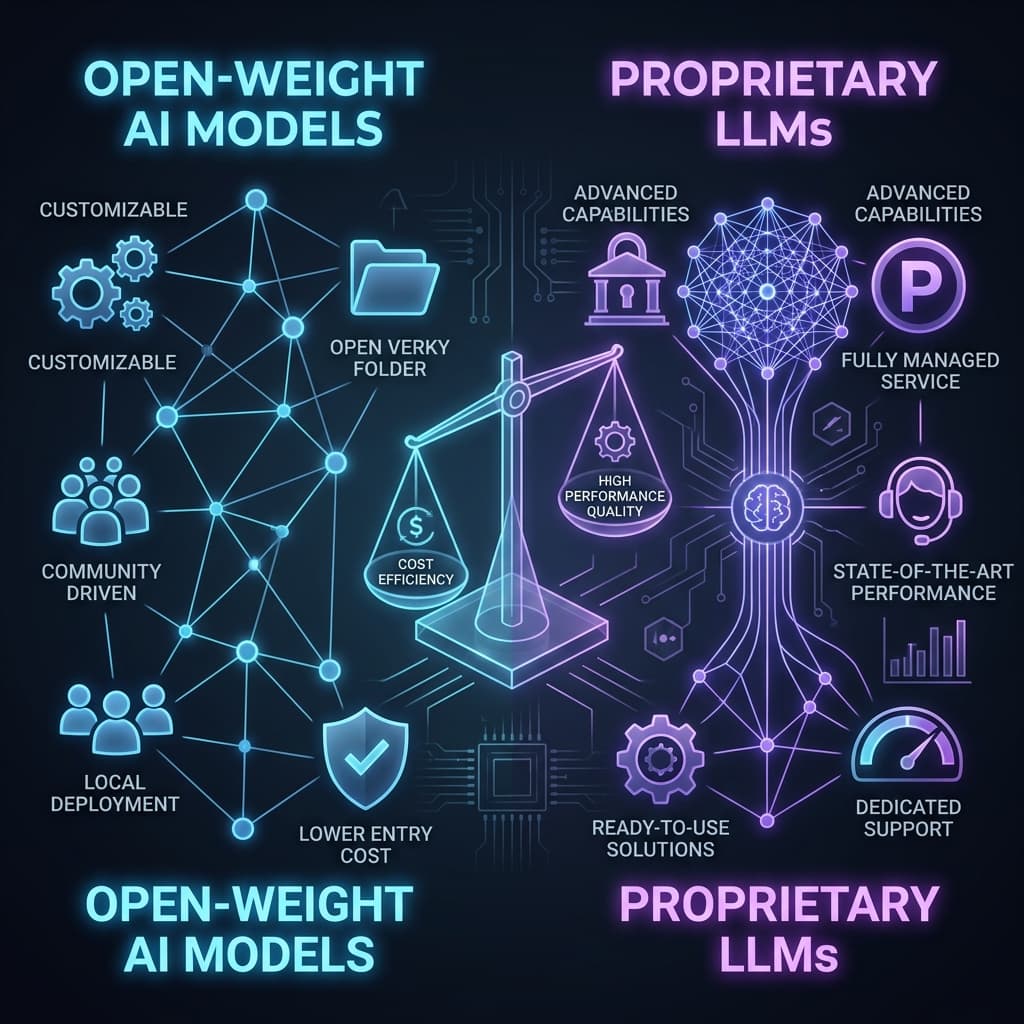
Open-Weight AI Models vs Proprietary LLMs: How to Get Better AI Development Economics in 2026
Why hosted open-weight models can deliver a much better price-to-quality ratio than expensive proprietary LLMs, and how developers can use them without buying a GPU.
The AI model with the highest benchmark score is not always the best choice
The easiest mistake to make when building with AI is assuming that the strongest model is automatically the best model.
It makes sense on paper. If Claude, GPT, Gemini, or another frontier model produces better code, why would you use anything else?
The problem is that software development is not one giant benchmark.
A lot of the work developers actually do is repetitive and well-defined: building interfaces, connecting APIs, generating components, making routine changes, fixing straightforward bugs, and turning a clear specification into working code.
For those tasks, paying a large premium for the absolute strongest model can be difficult to justify.
This is where open-weight models have become interesting.
The argument is not that open models have completely replaced proprietary LLMs. They haven't. The argument is that the price-to-quality gap has changed enough that you should probably stop assuming proprietary is always the best value.
What changed with open-weight models?
Open-weight models have improved rapidly, especially for coding and reasoning workloads.
Models such as DeepSeek V4, Qwen and other open-weight releases can now be accessed through hosted inference providers without requiring developers to own the hardware needed to run them.
DeepSeek V4 is a good example of this shift. NVIDIA's hosted endpoint currently provides access to DeepSeek V4 Pro and V4 Flash, while also offering deployment paths for teams that eventually want to self-host. DeepSeek V4 models support up to a 1 million token context window and are explicitly designed for coding and agentic workloads.
That changes the equation considerably.
You don't necessarily have to choose between:
- Paying for an expensive proprietary API, or
- Buying a GPU and becoming an infrastructure company.
There is now a third option:
Use hosted inference for an open-weight model and only pay for the compute you actually use.
That is probably the most practical way for most developers to experiment with open models today.
Hosted open-weight models are the important part
When people talk about running open models, the conversation usually jumps straight to local hardware.
That's useful if you have the hardware, but it isn't realistic for most developers.
Large models require serious compute. Even when a model is technically available for download, actually serving it efficiently is a completely different problem.
Hosted inference removes most of that complexity.
You get an API endpoint, send your request, receive the output, and pay according to the provider's pricing model. Some providers also offer free or trial endpoints.
For example, NVIDIA's current DeepSeek V4 endpoint provides a hosted API as well as self-hosting options.
OpenCode Zen is another example of the hosted approach. It provides access to multiple models through OpenCode rather than requiring developers to manage their own infrastructure.
The interesting part is that the model can be open-weight without your development environment needing to be local.
The real comparison is price-to-quality, not price per token
This is where I think a lot of comparisons get the question wrong.
Looking only at token prices tells you that one model is cheaper.
Looking only at benchmarks tells you that another model is better.
Neither answers the question most developers actually care about:
How much useful work am I getting for the money I'm spending?
A proprietary model can be significantly better on a difficult coding task and still be worse value overall if the improvement doesn't matter for the majority of your workload.
Recent pricing illustrates how large the gap can become. DeepSeek V4 Flash, for example, was reported in August 2026 at $0.14 per million input tokens and $0.28 per million output tokens. Reuters, citing Artificial Analysis, reported an average benchmark-test cost of around $0.03 for V4 Flash.
The exact prices will change. They always do.
The more important trend is that open-weight models are making it possible to get increasingly capable output without paying frontier-model pricing for every request.
You don't need the best model for every task
This is probably the biggest practical lesson.
Imagine you're building a web application and your AI coding agent needs to create a component, connect an endpoint, modify a form, or generate some repetitive frontend code.
You can send that request to the most expensive model available.
But why?
If a cheaper open-weight model can produce code that is good enough after a quick review, the expensive model isn't necessarily adding much value.
This is especially relevant for frontend-heavy development.
I've used DeepSeek V4 for frontend work and found it good enough for a large portion of the work. It isn't something I'd blindly trust with every difficult engineering decision, but it doesn't need to be.
The model only needs to be good enough for the task.
That distinction is important.
Where proprietary models still make sense
This isn't an argument to stop using Claude, GPT, Gemini or other proprietary models.
There are plenty of situations where paying for a stronger model is completely reasonable.
Complex architectural decisions, difficult debugging, large repository changes, security-sensitive work and problems requiring extensive reasoning can justify the premium.
If a $20 or $50 model call saves several hours of engineering time, you've probably made a good trade.
The mistake is using that model for everything by default.
A better approach is to think of model choice as an engineering decision.
Use the expensive model when the problem is expensive.
Use a cheaper model when the problem isn't.
The hybrid approach is probably the sweet spot
For most developers, I don't think the future is going to be purely open models or purely proprietary models.
It's going to be a mixture.
A development workflow could look something like this:
Open-weight model → routine development
Use it for straightforward implementation, frontend work, boilerplate, documentation, simple debugging and other predictable tasks.
Proprietary frontier model → difficult problems
Use it when you actually need stronger reasoning, complex codebase understanding or difficult debugging.
Human review → everything important
Neither approach removes the need to review generated code.
This gives you something better than simply choosing the cheapest model.
You get cost control without giving up access to stronger models when they actually matter.
Why hosted inference is currently more practical than self-hosting
Self-hosting still has legitimate advantages.
You control the infrastructure. You can keep workloads private. You can optimize inference for your own traffic. At sufficient scale, the economics can become attractive.
But there is a hidden cost that gets ignored in a lot of "just self-host it" discussions.
Someone has to operate it.
GPUs cost money. Infrastructure costs money. Engineering time costs money. Scaling, monitoring, model updates and inference optimization all take work.
For an individual developer or early-stage startup, buying hardware just to avoid API costs often makes little sense.
Hosted open-weight inference gives you most of the interesting part without forcing you to deal with the infrastructure yourself.
And if your workload eventually becomes large enough to justify self-hosting, you can make that decision later.
Open-weight models don't have to be permanently behind proprietary models
Another reason I think this trend matters is that the gap isn't static.
Open-weight models are improving.
DeepSeek V4 is already a good example. NVIDIA describes V4 Pro as a 1.6 trillion parameter model with 49 billion active parameters, while V4 Flash has 284 billion total parameters with 13 billion active parameters. Both support 1 million token contexts.
There is also growing evidence that open-weight models can perform competitively on specific coding and reasoning workloads. For example, recent research using DeepSeek V4 Pro reported strong repository-level feature development results under a specific coding-agent setup.
That doesn't mean open models are universally better.
It means the assumption that open models are automatically "cheap but bad" is becoming increasingly outdated.
How to evaluate an open model for your own workflow
Don't decide based only on a leaderboard.
Take the tasks your team actually performs and test the model against them.
For example:
- Generate a frontend component from a specification.
- Modify an existing component.
- Connect a frontend page to an API.
- Fix a known bug.
- Refactor a repetitive section.
- Add a small feature to an existing repository.
- Explain and modify unfamiliar code.
Then measure three things:
1. Output quality
Does the generated code actually work?
2. Human correction time
How much time do you spend fixing what the model produced?
3. Total cost
How much are you paying to get the finished result?
The third number is often the most interesting.
A model that costs 10x less but requires 3x more correction can still be an excellent deal.
A model that costs 10x more but saves 20 minutes on every task might also be worth it.
That's why price-to-quality is a much more useful metric than price alone.
The biggest mistake is choosing your model once
AI development changes too quickly for that.
A model that was clearly worth paying for six months ago might have a cheaper alternative today.
Likewise, an open model that wasn't good enough for your workflow yesterday might become perfectly usable after a new release.
Your stack should be flexible enough to switch models without rebuilding your entire application around one provider.
This is another reason model-agnostic coding agents and OpenAI-compatible APIs are useful. They make experimentation much easier.
A practical way to start
If you want to experiment with this without buying hardware, keep it simple.
Start with a hosted open-weight model.
Try it on a real project rather than a benchmark.
Give it a few tasks you normally send to Claude, GPT or another proprietary model.
Compare the output.
Then compare the amount of correction you needed and the actual cost.
If the cheaper model gets you 90% of the way there, you now have a very different cost structure.
You don't need to replace your existing model.
You just stop using the expensive one for tasks that don't require it.
The bigger shift
I don't think the interesting part of open-weight AI is that it is cheaper.
It's that the definition of "good enough" is changing.
When an open-weight model costs a fraction of a proprietary model and can still handle a large portion of your everyday development work, the expensive model has to justify the difference.
Sometimes it will.
Sometimes it won't.
And that's exactly how model selection should work.
The best AI stack isn't necessarily the one with the highest benchmark score. It's the one that gives you the right level of quality for the work you're actually doing at a cost that makes sense.
For developers and startups, hosted open-weight models are making that choice much more interesting than it was even a year ago.
Frequently Asked Questions
Are open-weight AI models cheaper than proprietary LLMs?
Often, yes, especially for high-volume inference. But the more useful comparison is cost-to-quality. A cheaper model that requires substantially more human correction may not actually be cheaper for your workflow.
Do I need a powerful GPU to use open-weight AI models?
No. Hosted inference providers can serve open-weight models through APIs, so you can use them without owning the hardware required to run the model yourself.
Should I use a hosted open-weight model or run an LLM locally?
For most individual developers and early-stage teams, hosted inference is the easier starting point. Local or self-hosted inference becomes more interesting when privacy, control, predictable high-volume usage, or infrastructure economics justify the additional complexity.
Can open-weight models replace Claude or GPT?
Not universally. Frontier proprietary models still have advantages on some difficult reasoning and engineering tasks. The practical approach is to use open-weight models where they provide sufficient quality and reserve proprietary models for tasks where their additional capability is worth paying for.
What is the advantage of hosted open-weight models?
They give developers access to open-weight models without requiring them to buy and maintain GPUs. This creates a middle ground between expensive proprietary APIs and fully self-hosted AI infrastructure.
What should I compare when choosing an AI model?
Look at output quality, correction time, reliability, token cost, context requirements and the total cost of completing a task. Benchmark scores and token prices are useful, but neither tells you the full cost of getting useful work done.
Build smarter, not just bigger
The AI model landscape is moving too quickly for developers to permanently commit to one provider or assume the most expensive option is automatically the best.
Open-weight models give startups and developers another option: use hosted inference when you want simplicity, self-host when the economics justify it, and keep proprietary models available for the problems where they actually provide meaningful value.
At Acumo AI, we take the same approach when building AI products: the model and infrastructure should be selected around the actual workload, not simply because it is the newest or most expensive option.